The definitive linguistic analysis of Xwótqwem comes from Brent Galloway (professor emeritus, First Nations University of Canada) and Allan Richardson (consulting anthropologist, Whatcom Community College), who began their joint research in August 1979 with formal approval from the Nooksack Tribe and funding from the Melville and Elizabeth Jacobs Research Fund.
Their 1983 conference paper and comprehensive 2011 book, Nooksack Place Names: Geography, Culture, and Language (UBC Press), document over 150 Nooksack place names with full phonetic transcriptions, phonemic analyses, and etymologies. This is 35 years of scholarship, conducted with the blessing and participation of the Nooksack Tribe. It is the foundation everything else rests on.
The authoritative record
Entry #133 in Galloway and Richardson’s 1983 paper provides the definitive documentation:
Nooksack practical orthography: Xwótqwem
Phonetic transcriptions: [xwótkʷem] (Paul Fetzer’s notation), [xwótqʷem ~ x̌wótqʷem] (Galloway, from elders Louisa George, Esther Fidele, and others)
Phonemic form: /xʷótqʷem ~ x̌ʷatqʷem/
Definition: “Sound of water splashing or dripping fast and hard”
Location: Whatcom Creek and the camp at its mouth (NW side) on Bellingham Bay
Halkomelem cognate: /xʷótqʷem/ (“sound of water splashing or dripping fast, loud waterfall or hard rain”)
The Nooksack Tribe’s official Culture Program page confirms this directly: “Xwótqwem: Whatcom Creek and camp at mouth of Whatcom Creek. [sound of water splashing or dripping fast and hard].”
The Lummi form, QwotQwem, was documented in a 2023 art installation by Children of the Setting Sun Productions, described as “the original Lummi word for Whatcom, meaning ‘noisy waters’ in Xwlemi Chosen.”
Two nations, one place, shared vocabulary
The discrepancy between Lummi and Nooksack attribution reflects real history, not error. Both peoples used the creek mouth as a seasonal fishing encampment. Both languages are Central Coast Salish with cognate vocabulary. The name was shared across linguistic boundaries, as was the place itself.
Popular sources (Whatcom County’s website, the Port of Bellingham, tourism bureaus) tend to attribute the word to the Lummi because settlers first encountered it through Lummi intermediaries. The linguistic scholarship, however, documents it as part of the Nooksack place name system. Both attributions carry cultural legitimacy.
The word is also the name of a Nooksack chief. H.H. Bancroft wrote that the county “was named after a chief of the Nooksacks, whose grave is a mile above the Bellingham Bay Coal mine.” Edmond S. Meany synthesized both traditions in Origin of Washington Geographic Names (1923), noting a county, lake, creek, and former city all named for a chief, though the place name likely predates the personal name as an Indigenous toponym tied to the sound of the waterfall.
Why the spellings differ
Xwótqwem. QwotQwem. Xw’otqwem. Xwot’qom. These are not competing claims about a word. They are attempts by an alphabet that was never built to hold it. Entry #133 above records Paul Fetzer hearing [xwótkʷem] and Brent Galloway hearing [xwótqʷem ~ x̌wótqʷem]. Two trained linguists, one spoken word, different letters. Even “Xwótqwem” is what linguists call a practical orthography: a spelling chosen to be usable, not a spelling that is true.
The word is spoken. It was spoken for thousands of years before anyone wrote it down, and the writing has been catching up ever since, badly. So this site does not correct anyone’s spelling. Where a source wrote it their way, we keep their way. At the 2026 renaming ceremony at Maritime Heritage Park, Setting Sun Circle wrote Xw’otqwem, so that is the form that appears on that part of this site.
The people a word belongs to decide how it is said, spelled, and translated. Everyone else is a guest in it.
What “noisy water” flattens
The popular translation “noisy water” appears on the Whatcom County official website, in tourism materials, on the Port of Bellingham’s history page, and throughout local media. Variants include “noisy, rumbling water,” “noise of the waterfalls,” and “loud water.” Henry Gannett of the U.S. Geological Survey wrote in 1905 that it was “an Indian word said to mean ‘noisy water.’”
These translations are not wrong, but they flatten the original word’s specificity. Xwótqwem is onomatopoeic. It captures not just noise and water as separate concepts, but the particular acoustic quality of water falling fast and hard. Galloway and Richardson’s precise translation, “sound of water splashing or dripping fast and hard,” describes an auditory experience: the roar and percussive splash of a waterfall. The Halkomelem cognate extends this to encompass both loud waterfalls and the sound of hard rain, reinforcing the acoustic dimension.
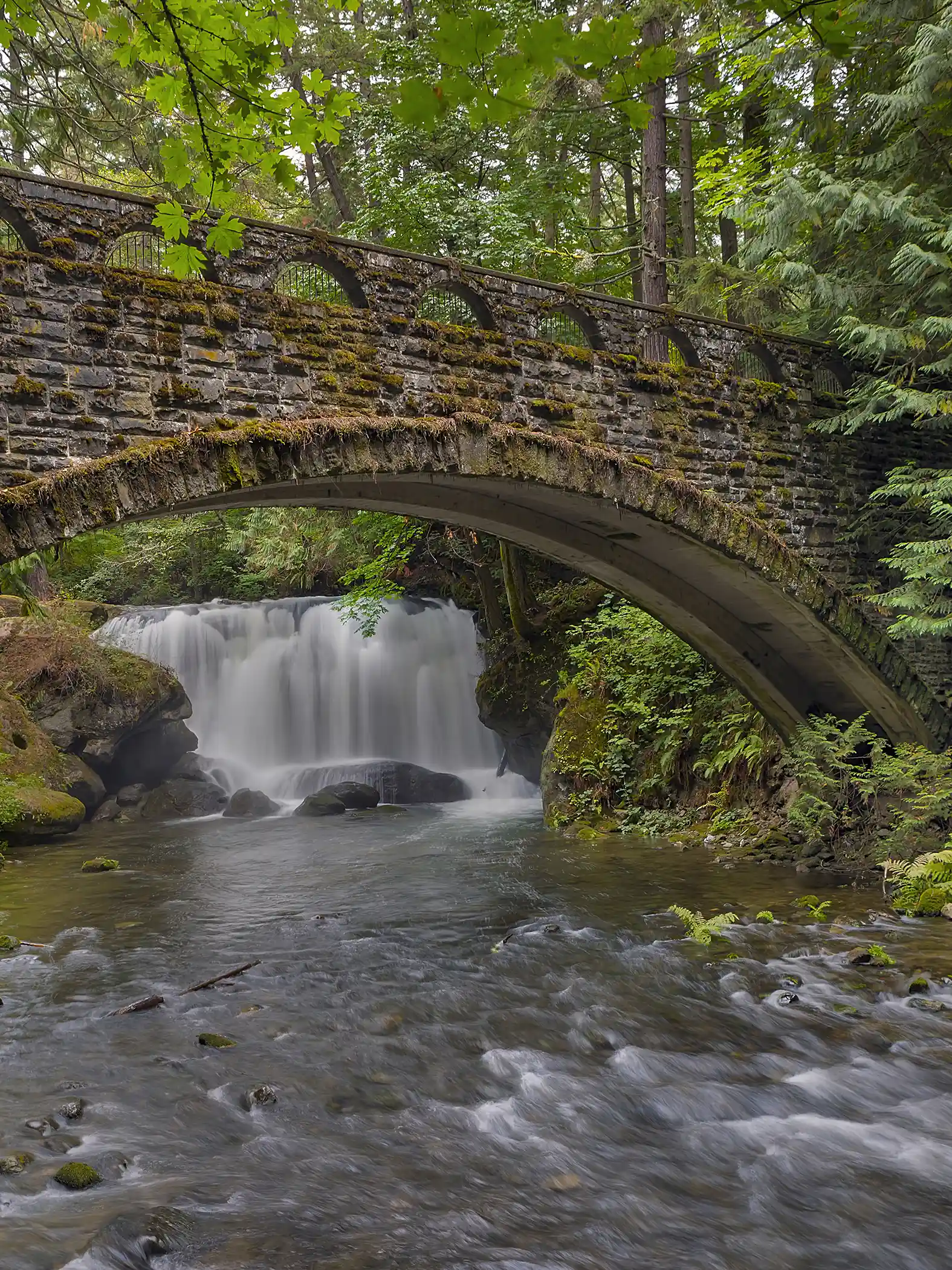
The specific waterfall referenced was the lower falls on Whatcom Creek, located between what are now Prospect Street and W. Holly Street in Bellingham. Galloway and Richardson note that this waterfall “probably plunged right into the ocean where now there is landfill for approximately 0.25 miles.” The word describes the sound of that particular place, at a time when the falls were dramatically closer to the sea than they are today.
What English erased
The phonology of the word reflects distinctive features of Salishan languages: the initial xʷ (a voiceless velar fricative with lip rounding), the uvular stop qʷ (produced deep in the throat with labialized articulation), and the suffix -em (common in Nooksack place names, also seen in Nuxwkw’ól7exwem for Squalicum Creek and Nuxwt’íqw’em for the Middle Fork Nooksack).
English speakers flattened /xʷótqʷem/ to “What-Coom” and eventually “Whatcom,” erasing both the uvular consonants and the acoustic meaning embedded in the original. The word went from a precise description of a soundscape to a label that means nothing in English.
The elders who preserved it
This word survives in the scholarly record because specific people chose to share it. Galloway and Richardson worked with Nooksack elders including Louisa George, Esther Fidele, George Swanaset, Sindick Jimmy (the last native speaker of Nooksack, d. 1988), and others. Wayne Suttles conducted earlier fieldwork with elders August Martin and George Swanaset in the 1940s and 1950s.
George Adams (Syélpxen), a fluent Nooksack speaker and director of the Lhéchalosem Teacher Training Program, has continued the work of language revitalization. Audio recordings of Nooksack place names in his voice were produced through the Nooksack Tribe’s language program. The Nooksack Tribe formally approved the place names research. These names (Galloway, Richardson, George, Fidele, Swanaset, Jimmy, Adams) deserve to be known.
Continue reading: The Place, on how the waterfall, the creek, and the camp became a county name.